Amit Shah and the March of BJP by Anirban Ganguly
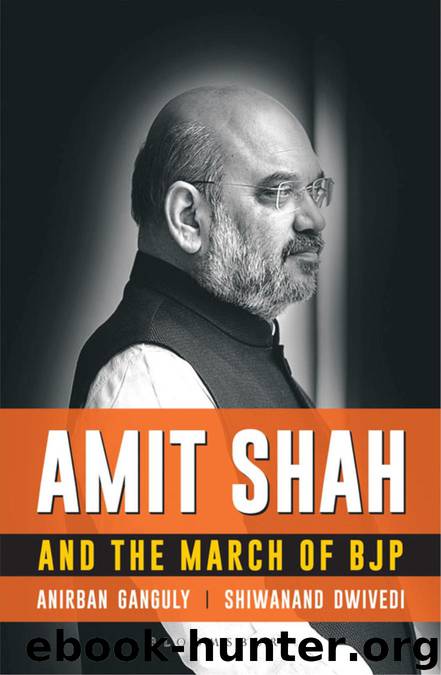
Author:Anirban Ganguly
Language: eng
Format: epub
ISBN: 9789388134132
Publisher: Bloomsbury Publishing
Published: 2019-11-25T00:00:00+00:00
• CHAPTER 8 •
THE CULTURE OF SAMVAD
Experience for Shah is what matters most when it comes to political work at the grassroots. His trudging from state to state, in a sense, from village to village,1 did not cease even after he became national president of the BJP. The scope and canvas of his tours had altered, it had widened and become multipronged. A crucial component of his countrywide tours across the first three years of his tenure as president was that of samvad. There is a well-established tradition of dialogue within the BJP, and in his three years, Shah had firmly reinforced and reinvented that tradition. It is a dimension which has been less discussed and analysed, and therefore it would be interesting to look at it and see how Shah has effectively used the medium of samvad in the last few years.
Several leaders in history have used different methods of dialogue to articulate and disseminate their ideas. In the early phase of the nationalist movement, leaders like Lokmanya Tilak, Sri Aurobindo and Bipin Chandra Pal, were master communicators, addressing mass meetings and at the same time, also effectively carrying on the struggle through their powerful and inspiring columns and editorials. It is said about Mahatma Gandhi that he was one of the greatest communicators of modern India. Former Congressman Natwar Singh once wrote that the Mahatma was ‘his own PR agency’.2 Indeed, Gandhi well understood the importance of samvad. He was aware of and effectively used all the means of samvad that were available in those days. Whether it was writing, broadcasting or public speaking, Gandhi, as a mass leader, made good use of these mediums to get into a dialogue with his people. His style of address was conversational; it set the tone for a samvad. Looking at contemporary politics one sees Narendra Modi as a super effective communicator. This has been widely acknowledged; during a book launch on 26 May 2017 at the Rashtrapati Bhavan, the then President of India, Pranab Mukherjee referred to Modi as a ‘very effective communicator’.3
On 23 June 2013, the martyrdom day of Syama Prasad Mookerjee, Modi who had now re-emerged on the national scene in Delhi after almost twelve years, launched his journey for a countrywide samvad. He addressed a massive rally in Pathankot; it was his first public meeting after gravitating once more towards national politics. Nearly eighty days after this first meeting, on 13 September 2013, Modi was declared as the BJP’s prime ministerial candidate. From 15 September 2013, Modi launched his historic electoral marathon, the series of samvad that he initiated across the country were to continue until 10 May 2014. This multifaceted dialogue through various means, meetings, discussion over tea—his famous Chai pe Charcha which caught the imagination of youth—interviews, all as part of his nationwide campaign, saw a record-breaking success.
According to figures outlined in the Mahamantri-Prativedan4 presented in 2016 by National General Secretary (Organisation) Ramlal, during this period of eight months, Modi had participated in 5,827 samvad programmes while travelling about 3 lakh kms.
Download
This site does not store any files on its server. We only index and link to content provided by other sites. Please contact the content providers to delete copyright contents if any and email us, we'll remove relevant links or contents immediately.
| Elections & Political Process | Ideologies & Doctrines |
| International & World Politics | Political Science |
| Public Affairs & Policy | Specific Topics |
| United States |
The Secret History by Donna Tartt(18975)
The Social Justice Warrior Handbook by Lisa De Pasquale(12172)
Thirteen Reasons Why by Jay Asher(8858)
This Is How You Lose Her by Junot Diaz(6846)
Weapons of Math Destruction by Cathy O'Neil(6231)
Zero to One by Peter Thiel(5743)
Beartown by Fredrik Backman(5693)
The Myth of the Strong Leader by Archie Brown(5476)
The Fire Next Time by James Baldwin(5398)
How Democracies Die by Steven Levitsky & Daniel Ziblatt(5186)
Promise Me, Dad by Joe Biden(5120)
Stone's Rules by Roger Stone(5060)
A Higher Loyalty: Truth, Lies, and Leadership by James Comey(4925)
100 Deadly Skills by Clint Emerson(4888)
Rise and Kill First by Ronen Bergman(4747)
Secrecy World by Jake Bernstein(4714)
The David Icke Guide to the Global Conspiracy (and how to end it) by David Icke(4665)
The Farm by Tom Rob Smith(4476)
The Doomsday Machine by Daniel Ellsberg(4464)
